> ## Documentation Index
> Fetch the complete documentation index at: https://api-docs.ollang.com/llms.txt
> Use this file to discover all available pages before exploring further.
# Source Files and Asset Handling
> Learn how source assets, supporting files, upload formats, and localization resources are managed inside the Ollang Project Management Dashboard.
## Overview
The Ollang Project Management Dashboard supports complex localization workflows involving:
* video files
* audio files
* subtitle srt files
* document files
* localization resource files
* guideline and reference materials
Each Project can contain a primary source asset and supporting assets. The selected Order type determines which asset is used for localization.
***
# Primary Source Assets vs Supporting Assets
## Primary Source Asset
A primary source asset is the main file that will be localized.
Examples:
* a video/audio file for Video Captioning, Subtitle Translation, or AI Dubbing
* a document file for Document Translation
## Supporting Assets
Supporting assets provide additional context or operational input for localization workflows.
Examples:
* SRT or VTT subtitle references
* M\&E files
* source audio
* glossaries
* brand guidelines
* voice instructions
* accessibility notes
* reference translations
* additional documents
A Project may contain multiple supporting assets, but the selected Order type determines which asset becomes operationally relevant.
***
# Example Project Asset Structure
```text theme={null}
Project: Product Demo Video
├── Primary Source Video
├── English SRT
├── M&E File
├── Translation Glossary
├── Brand Guidelines
├── Voice Instructions
└── Accessibility Notes
```
In this example:
* the source video is the primary asset
* the SRT supports subtitle timing and translation
* the M\&E file supports dubbing workflows
* the glossary and brand guidelines support consistency
***
# Supported Video and Audio Upload Formats
The following video and audio formats are supported:
Commonly used for source video localization workflows.
Commonly used for video captioning, subtitle translation, and dubbing workflows.
Commonly used for audio-based dubbing, transcription, and voice workflows.
Commonly used for audio upload, transcription, and voice-related workflows.
***
# Supported Document Upload Formats
The following document and localization file formats are supported:
These formats support workflows such as:
* office document translation
* website and HTML localization
* software localization
* structured resource file localization
* multilingual documentation workflows
***
# Structured Localization Files
Ollang supports structured localization formats such as:
* XLIFF
* SDLXLIFF
* JSON
* PO
* HTML
* SRT
* VTT
These formats are commonly used by:
* localization teams
* product teams
* engineering teams
* SaaS companies
* enterprise content teams
Structured file support allows organizations to localize content while preserving file structure and localization context.
***
# Subtitle and Caption Assets
Subtitle and caption files can be used as:
* primary assets for subtitle-based workflows
* supporting references for video workflows
* timing references for dubbing workflows
Common subtitle-related formats include:
* `.srt`
* `.vtt`
## Example
```text theme={null}
Project contains:
- Source Video
- English SRT (Source)
Possible Orders:
- Subtitle Translation using the source SRT
- AI Dubbing
```
In this case, the SRT can help preserve timing, segmentation, and subtitle structure during localization.
***
# M\&E Files
## What is an M\&E File?
M\&E stands for Music and Effects.
An M\&E file contains:
* background music
* environmental audio
* sound effects
* non-dialogue audio elements
without the original spoken vocals.
M\&E files are especially important for:
* AI Dubbing
* Studio Dubbing
* vocal replacement workflows
* professional audio mixing workflows
***
# Why M\&E Files Matter
During dubbing workflows, original vocals may be replaced with localized vocals.
M\&E files help preserve the non-dialogue parts of the original media, such as:
* background music
* crowd noise
* room tone
* sound effects
* environmental sounds
This allows localized dubbed audio to sound more natural and closer to the original production.
***
# Example Dubbing Workflow with M\&E
```text theme={null}
Source Video
↓
Ollang extracts the M&E or User uploads the M&E
↓
Generate Localized Vocals
↓
Mix Localized Vocals with extracted/uploaded M&E
↓
Generate Mixed Master Output
```
If a project already has a clean M\&E file, it can help improve dubbing and mixing workflows.
***
# Guideline Documents
Guideline documents provide instructions that help AI workflows, linguists, editors, and vendors produce consistent output.
Guidelines may include:
* subtitle style guides
* brand tone instructions
* terminology rules
* voice direction
* accessibility rules
* formatting preferences
* market-specific localization requirements
## Example
```text theme={null}
Guideline: Subtitle Style Guide
Rules:
- Maximum 42 characters per line
- Avoid splitting proper names across lines
- Preserve product names in English
- Use informal tone for social media content
```
## Hierarchy in which the Guidelines are applied to your orders
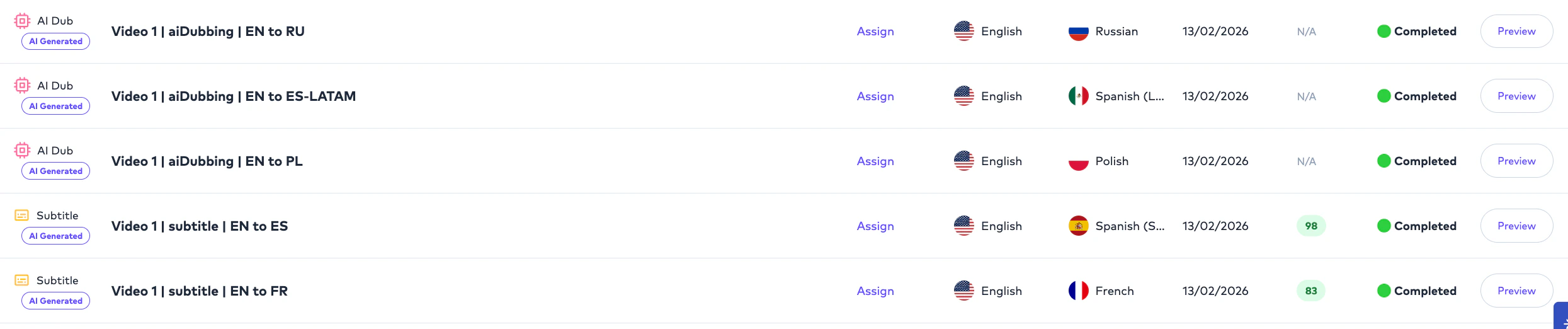
1. **Custom Instructions** represent global guidelines that are automatically applied to Orders when no folder-level or project-level guidelines are configured.
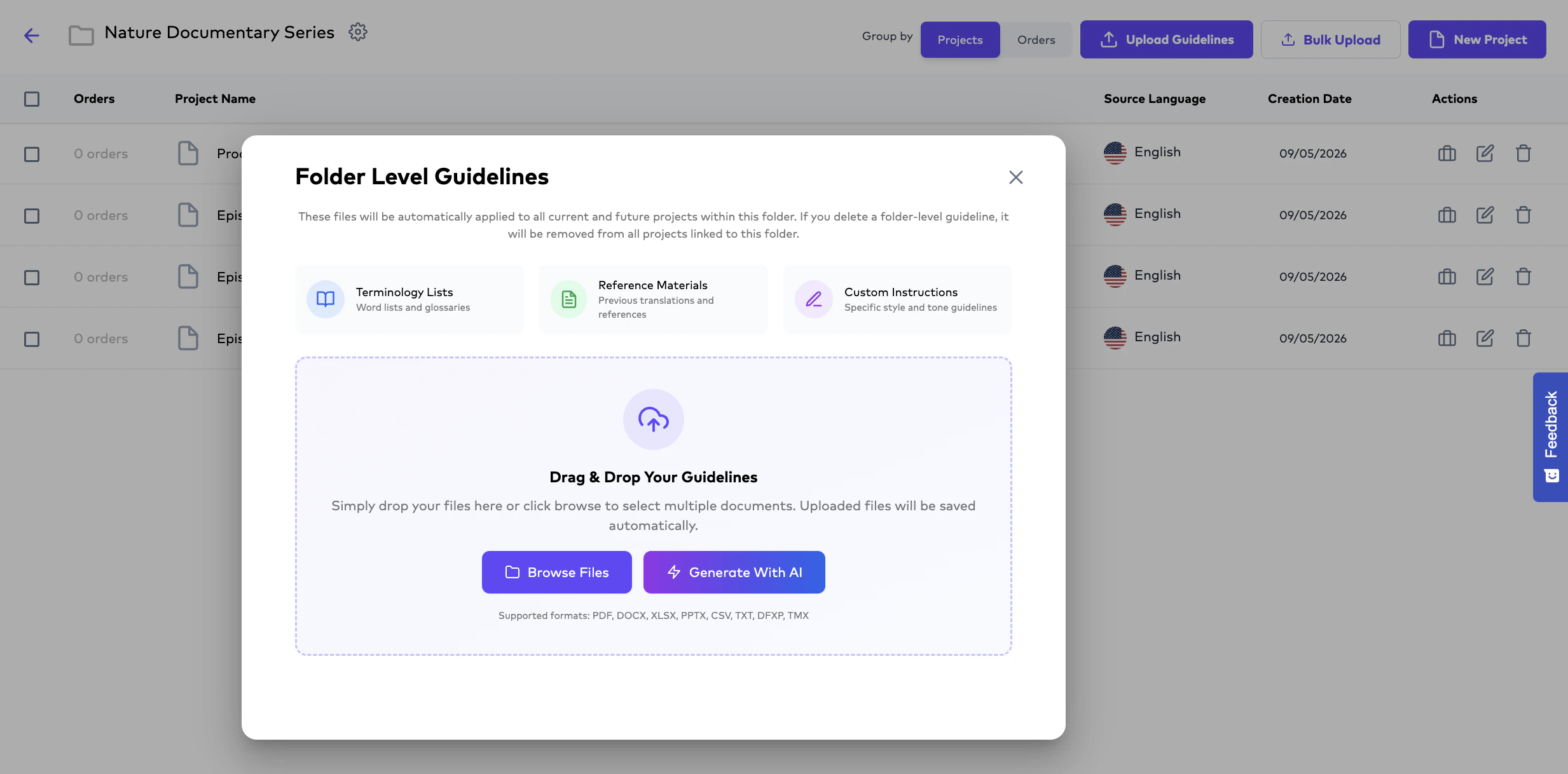
 2. **Folder-level Guidelines** represent instructions uploaded to a specific Folder and are automatically applied to all Orders within that Folder unless project-level guidelines are configured.
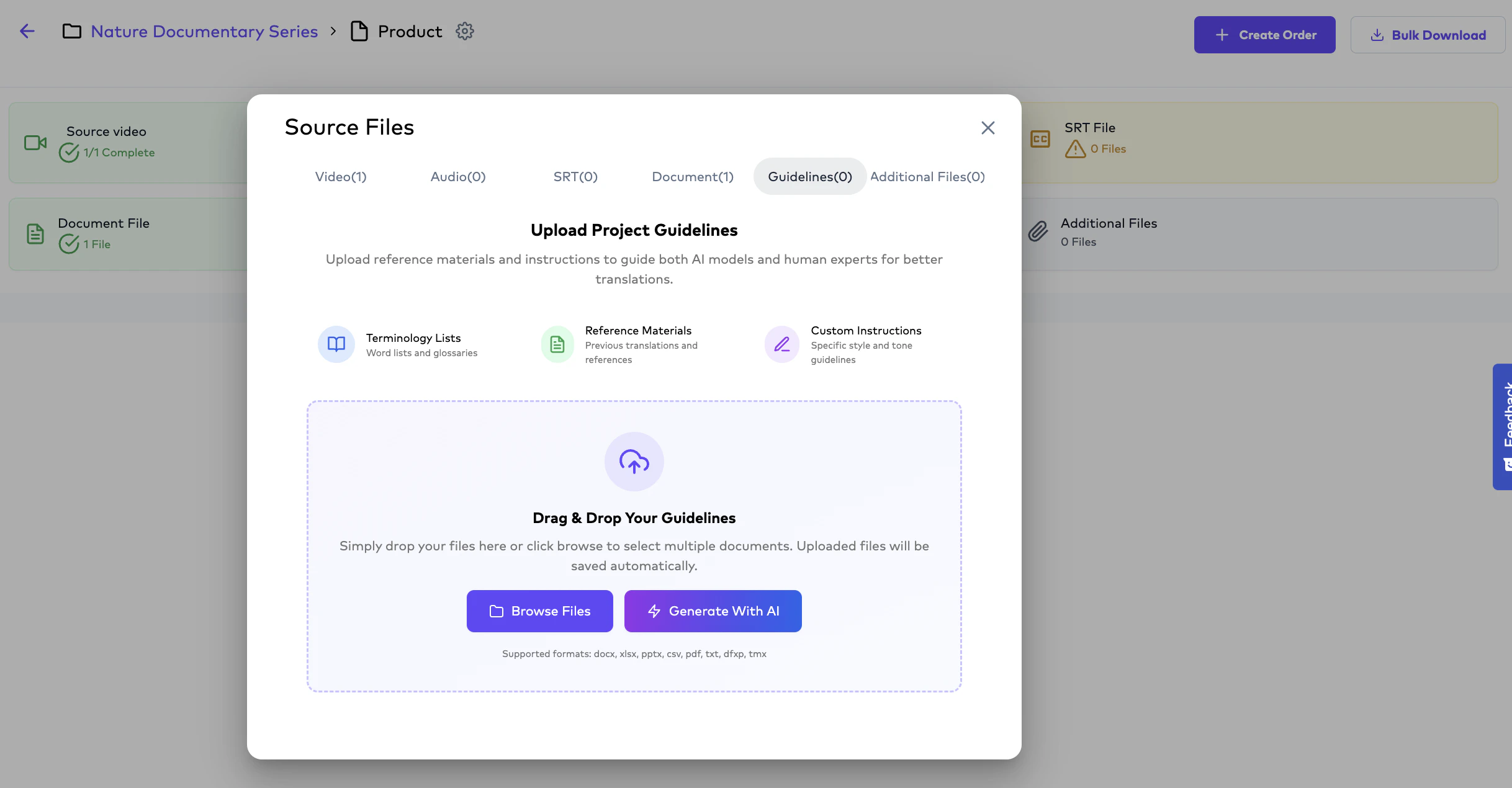
 3. **Project-level Guidelines** represent instructions uploaded to a specific Project and are automatically applied to all Orders within that Project, overriding folder-level and global guidelines when configured.
 # Glossaries and Terminology References
Glossaries help preserve terminology consistency across multilingual workflows.
They are useful for:
* product names
* brand terms
* medical terminology
* legal terminology
* UI terms
* recurring phrases
* approved translations
Glossaries are especially important for:
* enterprise localization
* SaaS localization
* legal translation
* healthcare content
* multilingual product operations
***
# Accessibility Assets
Accessibility-related assets may include:
* audio description instructions
* accessibility style guides
* screen-reader guidance
* narration tone notes
* compliance requirements
* scene description references
These assets support workflows such as:
* Audio Description
* captioning
* subtitle accessibility
* inclusive media localization
***
# Bulk Upload Workflows
Bulk Upload workflows allow Project Management Users to upload multiple files into a Folder for scalable project creation and localization management.\
\
Bulk uploads are especially useful for:
* Episodic content,
* Large multilingual campaigns,
* Media libraries,
* Enterprise localization operations,
* and high-volume content onboarding.\
\
The platform supports two different bulk upload methods:
Upload individual source files to create Projects one at a time.
Upload multiple structured folders simultaneously to automatically create multiple Projects with associated assets.
# Single File Upload Workflow
Project Management Users may upload:
* a single video,
* audio file,
* subtitle file,
* or document
to create:
* one new Project.
Additional supporting files may then be uploaded manually to enrich the Project.
Example:
```text theme={null}
Upload:
- ProductDemo.mp4
Result:
- Creates Project: ProductDemo
```
Additional files such as:
* subtitles,
* M\&E files,
* glossaries,
* guidelines,
* or supporting documentation
can later be added to the Project.
***
# Bulk Project Upload Workflow
## Overview
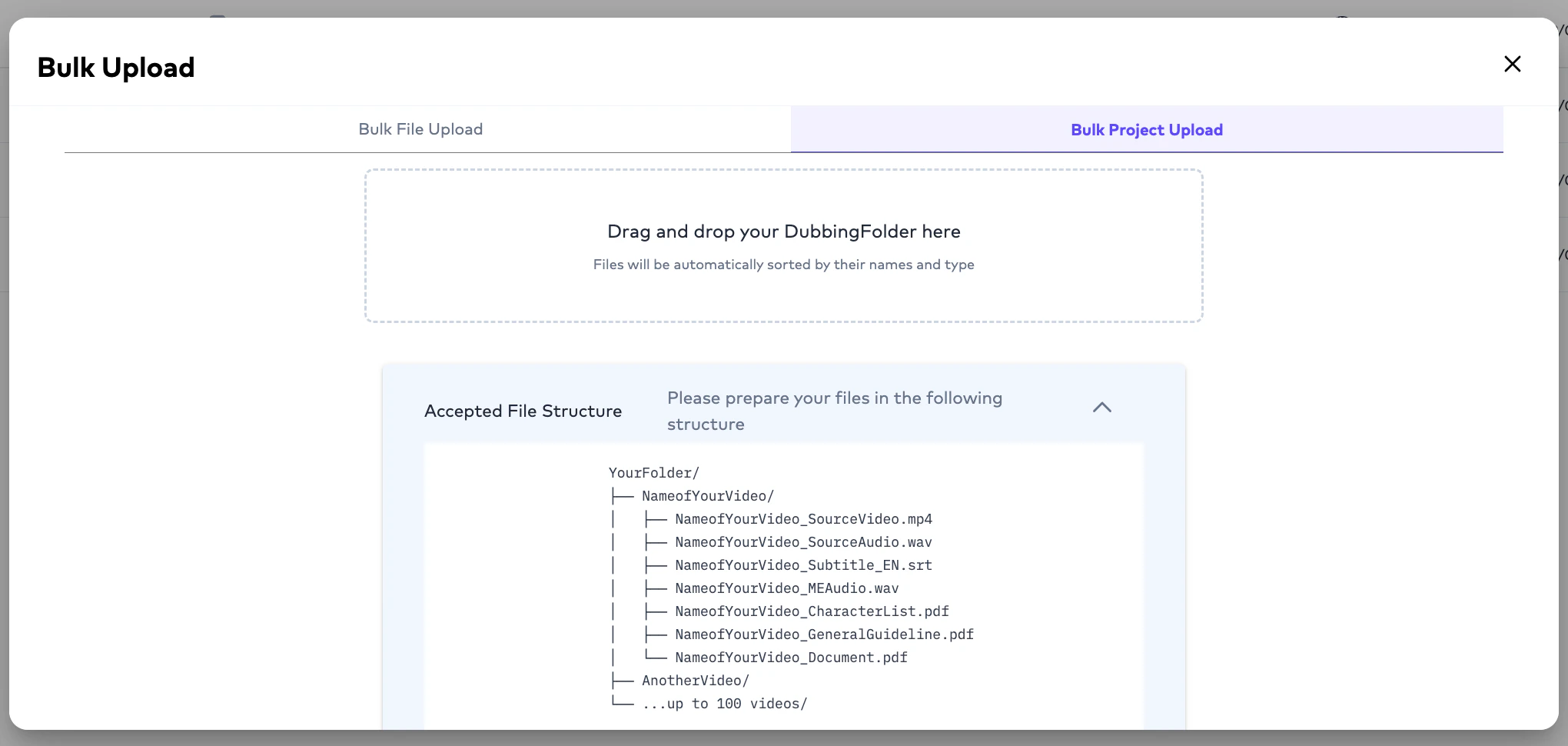
The platform also supports structured bulk project creation using:
* predefined folder naming conventions.
This workflow allows organizations to drag and drop:
* dozens or hundreds of folders simultaneously,
while automatically generating:
* Projects,
* associated source files,
* and supporting localization assets.
This is especially useful for:
* episodic media,
* multilingual production pipelines,
* enterprise-scale localization operations,
* and high-volume onboarding.
# Glossaries and Terminology References
Glossaries help preserve terminology consistency across multilingual workflows.
They are useful for:
* product names
* brand terms
* medical terminology
* legal terminology
* UI terms
* recurring phrases
* approved translations
Glossaries are especially important for:
* enterprise localization
* SaaS localization
* legal translation
* healthcare content
* multilingual product operations
***
# Accessibility Assets
Accessibility-related assets may include:
* audio description instructions
* accessibility style guides
* screen-reader guidance
* narration tone notes
* compliance requirements
* scene description references
These assets support workflows such as:
* Audio Description
* captioning
* subtitle accessibility
* inclusive media localization
***
# Bulk Upload Workflows
Bulk Upload workflows allow Project Management Users to upload multiple files into a Folder for scalable project creation and localization management.\
\
Bulk uploads are especially useful for:
* Episodic content,
* Large multilingual campaigns,
* Media libraries,
* Enterprise localization operations,
* and high-volume content onboarding.\
\
The platform supports two different bulk upload methods:
Upload individual source files to create Projects one at a time.
Upload multiple structured folders simultaneously to automatically create multiple Projects with associated assets.
# Single File Upload Workflow
Project Management Users may upload:
* a single video,
* audio file,
* subtitle file,
* or document
to create:
* one new Project.
Additional supporting files may then be uploaded manually to enrich the Project.
Example:
```text theme={null}
Upload:
- ProductDemo.mp4
Result:
- Creates Project: ProductDemo
```
Additional files such as:
* subtitles,
* M\&E files,
* glossaries,
* guidelines,
* or supporting documentation
can later be added to the Project.
***
# Bulk Project Upload Workflow
## Overview
The platform also supports structured bulk project creation using:
* predefined folder naming conventions.
This workflow allows organizations to drag and drop:
* dozens or hundreds of folders simultaneously,
while automatically generating:
* Projects,
* associated source files,
* and supporting localization assets.
This is especially useful for:
* episodic media,
* multilingual production pipelines,
* enterprise-scale localization operations,
* and high-volume onboarding.
 # How Bulk Project Upload Works
Each Project should exist inside:
* its own dedicated folder.
Inside each folder:
* files must follow a consistent naming structure.
When uploaded:
* each folder becomes a Project,
* and all associated files are automatically linked to that Project.
# Example Folder Structure
```text theme={null}
YourFolder/
│
├── NameofYourVideo/
│ ├── NameofYourVideo_SourceVideo.mp4
│ ├── NameofYourVideo_SourceAudio.wav
│ ├── NameofYourVideo_Subtitle_EN.srt
│ ├── NameofYourVideo_MEAudio.wav
│ ├── NameofYourVideo_CharacterList.pdf
│ ├── NameofYourVideo_GeneralGuideline.pdf
│ └── NameofYourVideo_Document.pdf
│
├── AnotherVideo/
│
└── ...up to 100 videos/
```
# What Happens During Upload?
When the folder is dragged into Ollang:
```text theme={null}
100 Structured Folders Uploaded
↓
100 Projects Automatically Created
↓
Associated Files Automatically Linked
↓
Projects Become Ready for Order Creation
```
For each Project:
* source videos are identified,
* subtitle references are linked,
* M\&E assets are associated,
* guidelines are attached,
* and supporting files are preserved.
This significantly reduces:
* manual onboarding effort,
* repetitive uploads,
* and project setup time.
# Benefits of Bulk Project Upload
Bulk project upload helps organizations:
* onboard large media libraries faster,
* reduce manual project creation,
* preserve structured file relationships,
* standardize localization operations,
* and accelerate multilingual order creation.
Bulk Upload workflows are especially recommended for organizations managing high-volume localization pipelines or episodic content libraries.
Bulk uploads may include:
* source videos
* subtitle files
* M\&E files
* documents
* additional reference files
The platform can then organize these assets for downstream localization workflows.
***
# Upload Behavior by Workflow Type
AI Dubbing workflows commonly use source video or audio files, subtitle references, M\&E files, and voice instructions.
Subtitle Translation workflows commonly use source videos, SRT/VTT files, subtitle references, glossaries, and formatting guidelines.
Video Captioning workflows commonly use source video or audio files to generate timed transcription and caption outputs.
Document Translation workflows commonly use office files, structured localization files, subtitle files, and website localization resources.
Studio Dubbing workflows commonly use source video, subtitle timing assets, dubbing scripts, M\&E files, and externally produced studio deliverables.
# Multi-Workflow Project Example
A single Project can support multiple Orders using the same source and supporting assets.
```text theme={null}
Project: Product Launch Video
Assets:
- Source Video
- English SRT
- Brand Guidelines
- M&E File
- Voice Notes
Orders:
- French Subtitle Translation
- German AI Dubbing
- Japanese Studio Dubbing
```
This allows teams to manage different localization outputs from the same Project environment.
# Important Operational Notes
Yes. A Project may contain multiple asset types. The selected Order type determines which asset is used for localization.
Yes. Subtitle file such as SRT can be used in subtitle-based localization workflows and can also support video or dubbing workflows.
The primary source asset is the main file being localized. Supporting assets provide additional context, timing, terminology, audio layers, or workflow guidance.
M\&E files preserve background music and effects while localized vocals replace the original spoken audio.
Yes. Multiple Orders under the same Project can reuse the same primary source asset and supporting files.
# How Bulk Project Upload Works
Each Project should exist inside:
* its own dedicated folder.
Inside each folder:
* files must follow a consistent naming structure.
When uploaded:
* each folder becomes a Project,
* and all associated files are automatically linked to that Project.
# Example Folder Structure
```text theme={null}
YourFolder/
│
├── NameofYourVideo/
│ ├── NameofYourVideo_SourceVideo.mp4
│ ├── NameofYourVideo_SourceAudio.wav
│ ├── NameofYourVideo_Subtitle_EN.srt
│ ├── NameofYourVideo_MEAudio.wav
│ ├── NameofYourVideo_CharacterList.pdf
│ ├── NameofYourVideo_GeneralGuideline.pdf
│ └── NameofYourVideo_Document.pdf
│
├── AnotherVideo/
│
└── ...up to 100 videos/
```
# What Happens During Upload?
When the folder is dragged into Ollang:
```text theme={null}
100 Structured Folders Uploaded
↓
100 Projects Automatically Created
↓
Associated Files Automatically Linked
↓
Projects Become Ready for Order Creation
```
For each Project:
* source videos are identified,
* subtitle references are linked,
* M\&E assets are associated,
* guidelines are attached,
* and supporting files are preserved.
This significantly reduces:
* manual onboarding effort,
* repetitive uploads,
* and project setup time.
# Benefits of Bulk Project Upload
Bulk project upload helps organizations:
* onboard large media libraries faster,
* reduce manual project creation,
* preserve structured file relationships,
* standardize localization operations,
* and accelerate multilingual order creation.
Bulk Upload workflows are especially recommended for organizations managing high-volume localization pipelines or episodic content libraries.
Bulk uploads may include:
* source videos
* subtitle files
* M\&E files
* documents
* additional reference files
The platform can then organize these assets for downstream localization workflows.
***
# Upload Behavior by Workflow Type
AI Dubbing workflows commonly use source video or audio files, subtitle references, M\&E files, and voice instructions.
Subtitle Translation workflows commonly use source videos, SRT/VTT files, subtitle references, glossaries, and formatting guidelines.
Video Captioning workflows commonly use source video or audio files to generate timed transcription and caption outputs.
Document Translation workflows commonly use office files, structured localization files, subtitle files, and website localization resources.
Studio Dubbing workflows commonly use source video, subtitle timing assets, dubbing scripts, M\&E files, and externally produced studio deliverables.
# Multi-Workflow Project Example
A single Project can support multiple Orders using the same source and supporting assets.
```text theme={null}
Project: Product Launch Video
Assets:
- Source Video
- English SRT
- Brand Guidelines
- M&E File
- Voice Notes
Orders:
- French Subtitle Translation
- German AI Dubbing
- Japanese Studio Dubbing
```
This allows teams to manage different localization outputs from the same Project environment.
# Important Operational Notes
Yes. A Project may contain multiple asset types. The selected Order type determines which asset is used for localization.
Yes. Subtitle file such as SRT can be used in subtitle-based localization workflows and can also support video or dubbing workflows.
The primary source asset is the main file being localized. Supporting assets provide additional context, timing, terminology, audio layers, or workflow guidance.
M\&E files preserve background music and effects while localized vocals replace the original spoken audio.
Yes. Multiple Orders under the same Project can reuse the same primary source asset and supporting files.